
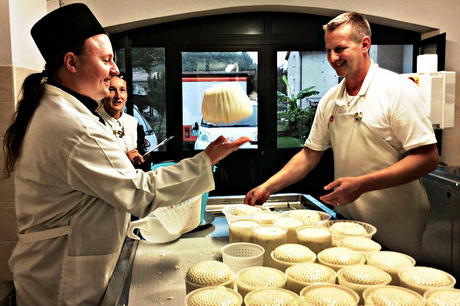
Monks of the Valaam Monastery are going to manufacture cheeses being hit by anti-sanctions, including Mozzarella, Caciotta, Morlacco, Ricotta Affumicata, and Dolche Bianka. The state-of-the-art cheese-making equipment has already been purchased. The monk in charge of the Monastery farm Agapy completed his training in Italy with the local masters. According to the monastery members, the production of Italian cheeses will start in 1.5-2 months.
Russian monk of the Valaam Monastery was invited to complete the short-term training in cheese-making by an Italian firm engaged in making equipment for the production of refined cheeses. The training was provided from October 5 to October 11 in Italy. After that the Valaam Monastery has purchased the necessary equipment which one of these days will be delivered to Valaam situated on Lake Ladoga. Father Agapy managing the Monastery farm learned to make five kinds of cheeses: Mozzarella, Caciotta, Morlacco, Ricotta Affumicata, and Dolche Bianka.
“The equipment has already been purchased, but the cheese has not being produced yet. We need time to customize the equipment, install and test it. I think it will take at least one and a half month. Actually, it’s just a revival of traditions,” he told.
Before the revolution the Valaam Monastery was the first to try innovative technologies.
“For example, the water pipe appeared here right after Europe. We would like to use the cutting-edge technologies as it was back in the day. There’re not many people in the Monastery, and they need to employ such technologies to accelerate processes and cut down expenses,” explained the spokesperson of the Valaam Monastery Mikhail Shishkov in the interview to Gazeta.ru.
According to the employees of the Monastery, at the moment the farm is under repairs. The new equipment for the production of cheese and other dairy products is being installed.
“The whole farm is being reorganized by Velesstroy Company. The construction work is performed by the gang from Serbia, and the Federal Grid Company handles all the financing. We removed everything from cow sheds to change their interior and exterior. We’ll install new Sweden equipment, and in the next few days we expect Italian cheese-making equipment to come. But now there’s no space to install the equipment. We have just walls at the moment. And only the head of the farm visited Italy, so the technologies need to be handed over to our milkman,” told the shepherd of the Valaam farm Alexey.
It’s worth to notice, that until 1917 the Valaam Monastery was one of the largest farming centers in the Northern part of Russia. It fully provided itself with the produce. At the end of XIX century the Monastery won the Grand Prix of agricultural trade show in Paris.
“Besides fruit-berry orchards with unique, but lean soil (the fertile layer is rarely more than 30 cm), the arboretum was created here. The Monastery had at its disposal the power-driven dairy farm with 70 cows. In the inner lakes of Valaam the brethren of the Monastery bred salmon, trout, and lake herring. 160 hectares of cropland and hayfields were worked. There were the drainage and irrigation facilities 100 km long,” says the web-site of the Valaam Monastery.
According to the Monastery farm, the dairy factory in process of construction is an attempt to revive the pre-revolutionary agricultural glory of the Monastery.

Comments (0)
Twitter
Facebook
Pinterest
E-mail