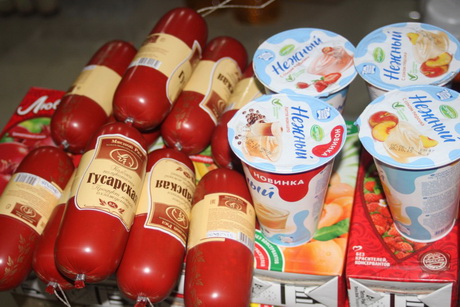
This year the Primorskiy Krai accounts for almost 40% of food exports (by value) from the Far East to foreign countries. Most of the food goes to China. Thousands of tons of food have already been imported to the province of Heilongjiang through automobile checkpoints, located in the zone of responsibility of the Ussuriysk customs service. Some figures are very revealing. So, 157 tons went on the exports of meat and meat products. In 2015, this figure was zero.
The demand exceeds the offer
A significant increase is noted in the demand for a number of other items. The volume of exported fish and crustaceans has literally skyrocketed — in 13 times; noodles and flour products — in 2.7 times, sugar and confectionery products — in 2.6 times.
The customs statistics is confirmed by data of the Export Development Center of the Primorskiy Krai. Sergei Kazakov, head of this center, says that this year companies, which cooperate with the EDC, have sent timber, construction materials, furniture, high-tech equipment and, of course, food to foreign markets.
“The EDC clients export seafood — shrimp, flounder, Siberian salmon, scallop, finished goods from agricultural raw materials, such as pasta, as well as honey, mineral water, alcoholic and non-alcoholic drinks, confectionery, ice cream, wild plants,” told Mr Kazakov, stressing that in 2015 the cost of products, exported by companies-partners of the EDC, reached 13 million US dollars, while in 2016 — 32 million US dollars. “Of course, the lion’s share of the increase is fish products. A significant increase has also been marked for ready-made foods, especially confectionery products.
More than 50% of trading partners of the EDC clients in the Primorskiy Krai are from China. The second and third places belong to the Republic of Korea and Japan.
Prices do not matter
Those who have been in China, especially in border areas, have long noticed that there is a huge number of shops, selling Russian products. Wheat flour, chocolate (especially Alyonka), canned fish, canned meat, ice cream, beer, mineral water — the Chinese are fond of these goods. They can be purchased not only in retail stores but also on e-commerce sites.
Zhao Dunljan, owner of one of these websites, geographically located in the Xinjiang Uighur Autonomous Region (Northwest China), says that when he was opening the project, he bet his Russian customers would be exactly food vendors. Currently there are 12,000 Chinese vendors, registered on the website, they sell clothing, footwear, and electronics. And only 98 Russian sellers, trading in food.
“We want to eat safe, environmentally friendly products. Russian goods meet these requirements. And prices are not important, because for many Chinese money is not the issue. Even if Russian products cost twice the price of Chinese analogues, our customers prefer them,” said Mr. Zhao.
According to the businessman, his company trusts more to Russian suppliers when it comes to quality.
“As far as I know, there are no fake goods in Russia, so we can trust documents, confirming consumer properties of food. With regard to Chinese suppliers, we send an employee to the company-producer, this person checks documents, as well as watches with his/her own eyes how products are made. In addition, we demand that producers should transfer a certain amount of collateral to our bank account. And if we get the goods of poor quality, we deduct the money from it,” he explained.
Fake ice cream
“Indeed, the process of obtaining necessary documents and permits for exports can take quite a while — due to the nature of the trade laws and regulations in other countries,” Sergei Kazakov confirms. “But positive examples of companies from the Primorskiy Krai show us that, given your desire, support of public authorities and interaction with foreign partners, this task can be solved successfully.
But in addition to documents, there are other problems,” he adds.
“Last year we started to supply ice cream from Arsenyevskiy Dairy Plant to China. In total, exports reached more than 600 tons. But right now I doubt whether it is worth to continue working here,” told Oleg Novikov, CEO of Stroy Mobil Group LLC. “The fact of the matter is that the market is flooded with counterfeit products, which are cheaper than ours, it becomes increasingly difficult to compete with them. Labels of these fakes often contain grammatical errors, but the Chinese do not know Russian and do not notice. Moreover, it is impossible to distinguish the taste of counterfeit goods from the real product. We brought fake ice cream from China and tested it in the laboratory. It is certainly not from natural products, as our product. But ordinary consumers do not notice it,” he shared.
The businessman adds that Chinese craftsmen forge not only ice cream. For example, a favorite cake of Russia’s neighbors — Medovik, honey cake, which is available in most of the stores near the border, is baked there, in underground shops. Recently he was in China and saw a fish, named “wild flying salmon” under the guise of Russian salmon.
Exports in a suitcase
Another problem is the so-called unorganized exports, when food is being driven across the border by tourists-chelnoks. Nikolai Loschinin, chief of the Ussuriysk customs service office, says that individuals export confectionery, candy, chocolate, flour, butter, coffee, dried and condensed milk, fish, seafood, alcoholic beverages.
Representatives of one of the exporting companies say that the problem is not only that these privately imported products will compete with official exports. It is that they can worsen the reputation of goods from Russia — for example, this food gets spoiled during the transportation but gets to stores anyway.

Comments (0)
Twitter
Facebook
Pinterest
E-mail