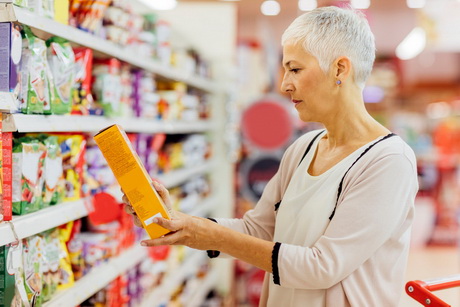
The labeling of ingredients in green, yellow and red colors tells customers how they comply with healthy eating principles. The Federal Service for Supervision of Consumer Rights Protection and Human Welfare of Russia offers to include “traffic light” labeling into new marking and labeling rules.
Many countries apply such labeling in various forms. Finland was one of the first to introduce a program to combat cardiovascular diseases more than 20 years ago, labeling products with high content of salt in red. As a result, salt consumption was reduced by half, and the number of heart attacks and strokes went down. A lot of food and beverage manufacturers in the UK also voluntarily print colorful icons on the packaging of their products to indicate the content of sugar, salt and fat. In the United States, manufacturers are obliged to indicate “tips” for consumers: “recommended daily dose”, “servings in the pack”, and specify the content of sugar, saturated and trans fats, as well as how much it is from daily consumption rates. To make it easier to control.
Products in Russia are also labeled, of course. However, it is easy to take in the information about calories, while the notorious “proteins-fats-carbs” look more like an abstraction. When you start to analyze the composition of complex products — the amount of each component simply is not indicated.
Food products in Russia are labeled in accordance with the Customs Union technical regulations. They establish general requirements for information to be included in the label, its placement on the packaging. The nutritional value of a product includes such indicators as calories, proteins, fats and carbohydrates, as well as vitamins and minerals.
But it is hardly possible to call these regulations conforming to modern requirements, officials say, explaining that the current regulations do not oblige manufacturers to inform consumers of the quantitative content of such essential food components as saturated fatty acids, sugar and salt in products. That means that buyers don't have an opportunity to choose a healthier product, even if they read the information on the label.
Meanwhile, the more sugar, salt, and saturated fatty acids we consume, the higher the risk of diseases of blood vessels and the heart, diabetes and other dangerous ailments.
That's why experts offer new labeling to indicate how much of the above is contained a particular product, plain and simple. The color system in relation to the quantity of sugar, salt, saturated fats, total fat content will make such markings visible and convenient for buyers. Assuming that all useful inscriptions are legible. Every third buyer complains that it is impossible to read the inscription on the packaging due to a very small font.
Anna Popova, head of Rospotrebnadzor, Chief State Sanitary Officer of Russia:
“The quality of food products is discussed a lot today, such an interest in it is a positive trend. This indicates that society is ready, that it has moved to a new level — people want to buy something that brings benefits, not anything goes. The state, in response to this request, has already developed and approved a strategy to improve food quality in the Russian Federation up to 2030. One of the objectives of this strategy is to promote healthy nutrition principles. Giving consumer complete and accurate information on the content of ingredients in the product, such as sugar, salt, saturated and trans fats, will help them make better purchase choices and promote respect for healthy nutrition principles. Accordingly, this will reduce risks to the health of citizens.
Two systems for marking and labeling of food products have been created to enable choosing a healthy balanced diet. The “traffic light” scheme provides information about fats, saturated fats, sugar and salt by a corresponding color: red, yellow, or green. These colors are used to indicate high, medium or low content of these ingredients in the product. The second system — daily rates. It aims at providing information on how many calories, fats, salt, sugar and fiber are contained in a product and how much they account for a percentage of the daily value.

Comments (0)
Twitter
Facebook
Pinterest
E-mail