
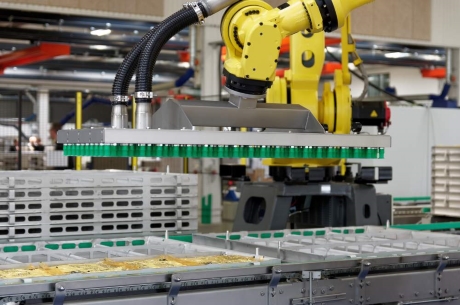
By 2025, machines will take over at least 25% of physically demanding, monotonous tasks or tasks that do not require intellectual effort, experts say.
Food manufacturers are actively introduce robotic lines. Robotization in Russia's food industry has already reached 12–15%. For comparison, in metallurgy and metalworking robotization is 28%, in the automotive industry — 12%.
The scope of application is quite wide. “For example, robots are used for butchering animal carcasses. This is important, human employees do not have to work in the refrigerator or freezer. Robots are equipped with computer vision and can independently determine where to make an incision. Sorting robots apply a similar technology: they have special suction cups or grips, quickly sort vegetables and fruits by size, colors or other parameters,” says Andrey Natashkin, founder of Mirey Robotics.
It is also popular to use robots for slicing bread, sausages, delicacies, vegetables and fruits. Unlike humans, such robots can work around the clock with high precision, which in turn guarantees a consistently high quality of food products. “Research and Markets, an analytical agency, estimates the market of robotic solutions in the food industry at two billion dollars. By 2031, the market may grow further to six billion dollars,” says Andrey Natashkin.
Many specialized technological solutions are being developed. “INNOFOOD 2023, an international forum and exhibition of goods and services for food companies, hosted presentations of many novelties: a fermenter with a precision fermentation technology in a closed system; an AI-powered steam convector oven, which allows you to cook several high-quality dishes at the same time without loss of taste; mobile mushroom farms; express tests for the diagnosis of diseases of agricultural plants; amaranth oil and flour, wheat juice, red and black rice, vegetable meat and milk,” says Vladimir Ilyichev, an expert on ethical nutrition.
Innovative solutions are required for food products, popular with modern people. In 2023, the top 10 products were rice, meat, cow’s milk, corn, soybeans, eggs, grain, bread, cereals and seafood, according to eWorldTrade. Plant-based analogues of animal products are also gaining popularity, as ethical nutrition is becoming more and more trendy. Innovative solutions in FoodTech and AgriTech are very functional: technology does a lot for a person.

Comments (0)
Twitter
Facebook
Pinterest
E-mail