Laboratories of the Altai State Technical University are working on a technology that could change the approach to cleaning industrial wastewater. Scientists are creating a sorbent, a special material that absorbs contaminants. It is made from what is typically considered waste: discarded snail shells and wood waste. Our article covers the project that could help solve one of the global environmental problems, such as river pollution.
Barnaul is located relatively close to the Ob River’s source. The water is still relatively clean here. But with each subsequent city, it becomes dirtier and dirtier. The river, of course, cleanses itself naturally, but not that efficiently. By the time it reaches the estuary, the water is significantly polluted, says Nikita Voronin, a lecturer at the International Department of Environmental Engineering.
Initially, the department worked on recycling plant-based food waste, and in the process, new waste was discovered — snail shells.
If waste appears, why not find a useful application for it. That's how we decided to produce sorbents, the scientist explains.
At first, they used simply ground shells. Experiments showed they could capture, for example, cobalt ions, turning pink. But there was a serious drawback: the fine shell particles themselves were washed out by water, creating new pollution, suspended solids like dust and sand.
The breakthrough idea was to use not the entire shell, but its base — chitin. This is a natural polymer that makes up the shell’s top layer. It can be extracted and chemically “stitched” with another common natural polymer, cellulose obtained from wood. Thus, a hybrid material was born.
We produced a substance that cleans water as effectively as activated carbon, sometimes even better. Exactly how it happens, whether it absorbs or binds, the details of the chemical process still need to be studied. But the main thing is: it works, says Nikita Voronin.
The material's operating principle is sorption, meaning absorption by a solid substance. In the case of whole shells, it is primarily physical absorption due to the material's large surface area and internal pores.
The new material, however, the chitin ester, is presumably capable of entering a chemical reaction with metal ions, binding them firmly.
Cellulose, figuratively speaking, is like cotton wool: it's a framework with a very high specific surface area. Chitin by itself, once extracted, is a fine powder that would wash away. But 'stitched' with cellulose, it becomes a convenient and practical filtering material, explains Nikita Voronin.
The team from the Department of Chemical Technology is responsible for turning the shell into this very “framework.” The process, overseen by its head, Candidate of Chemical Sciences Danil Yefryushin, is multi-stage and meticulous.
The process is not fast, admits Danil Yefryushin. First, the shells need to be ground to a sand-like state. Then remove proteins by treating with alkali so the mass doesn’t rot in the future. Next comes the most important stage: removing calcium carbonate, the very “shell rock.” For this, we treat the powder with acid. As a result, almost everything dissolves, and a thin layer remains at the bottom, that is pure chitin.
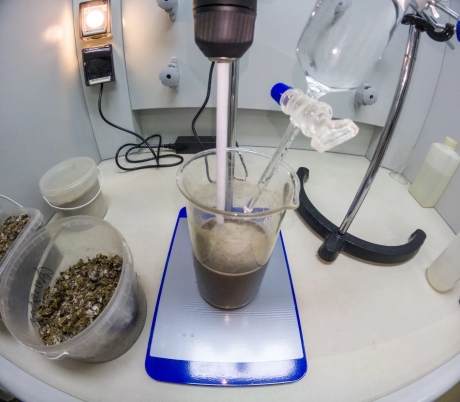
The obtained chitin is washed, dried, and sent for synthesis. In a reactor, it is mixed with a binding agent and cellulose purified from impurities, heated, and stirred. The result is a gray mass, resembling cotton wool, which can already be molded into filters.
We obtain the material in batches of 10-20 grams. That's enough to clean about 60 liters of water contaminated with cobalt ions thousands of times above the norm. And our material handles it, shares Vladimir Somyn, Doctor of Technical Sciences, head of the Department of Environmental Engineering.
The cleaning time for such a volume in the lab is 15-20 hours. But in real production, with different volumes, the process could take just 5-8 minutes. It all comes down to scaling up.
In terms of effectiveness, the new sorbent is already comparable to traditional ones. But its main "feature" is the raw material.
Our peculiarity is that shells aren’t used anywhere currently: it’s a waste product of the food industry. In the Altai region, there are snail farms, for example, in Nalobikha, says Nikita Voronin. Shells that used to be thrown away, we take and use for water purification. We turn waste into profit, creating a zero-waste cycle.
Shells from large Achatina snails as well as grape snails are suitable. Moreover, the source of cellulose can also be waste, wood chips and sawdust.
Even in restaurants where snails are served, shells remain. That is also our potential raw material, the scientist adds.
Industrial application is still far off. As Danil Yefryushin explains, they first need to complete laboratory research, obtain stable results on batches of the material, comprehensively study its properties, and what is critically important — patent the technology.
Patenting will take about a year. And then we will start offering the technology to businesses, Danil Yefryushin plans.
Will there be demand? The scientists look at it realistically. For large enterprises, implementing new technologies is unfamiliar, as they have worked for decades using traditional schemes. But small innovative companies, especially those focused on "green" technologies, might show interest. The market also appears promising abroad.
It all depends on which specific metals we demonstrate high effectiveness against. If there is demand for specific elements that our material captures well, demand will appear, believes Danil Yefryushin.
The work is carried out by an interdisciplinary team. Vladimir Somyn oversees the overall project. Danil Yefryushin from the Department of Chemical Technology is responsible for obtaining the sorption material. Nikita Voronin and his students from the Department of Environmental Engineering are engaged in testing and researching the cleaning properties. Students from the Altai State Technical University are also actively participating in the work.

Comments (0)
Twitter
Facebook
Pinterest
E-mail